West Michigan housing guide
West Michigan Home Appreciation: What the Long-Term Record Shows
See how Grand Rapids–Kentwood home values changed from 1995 through 2026, including the housing downturn, recent gains and lessons for Michigan buyers.
The regional benchmark used here
“West Michigan” can mean different collections of counties. For a consistent long-running measurement, this guide uses the Federal Housing Finance Agency All-Transactions House Price Index for the Grand Rapids–Kentwood metropolitan area. FHFA builds the series from home sales and appraisal information. It measures how prices change over time; it is not the dollar price of a typical house and does not describe every neighborhood or property type.
The long view: roughly four times the 1995 index level
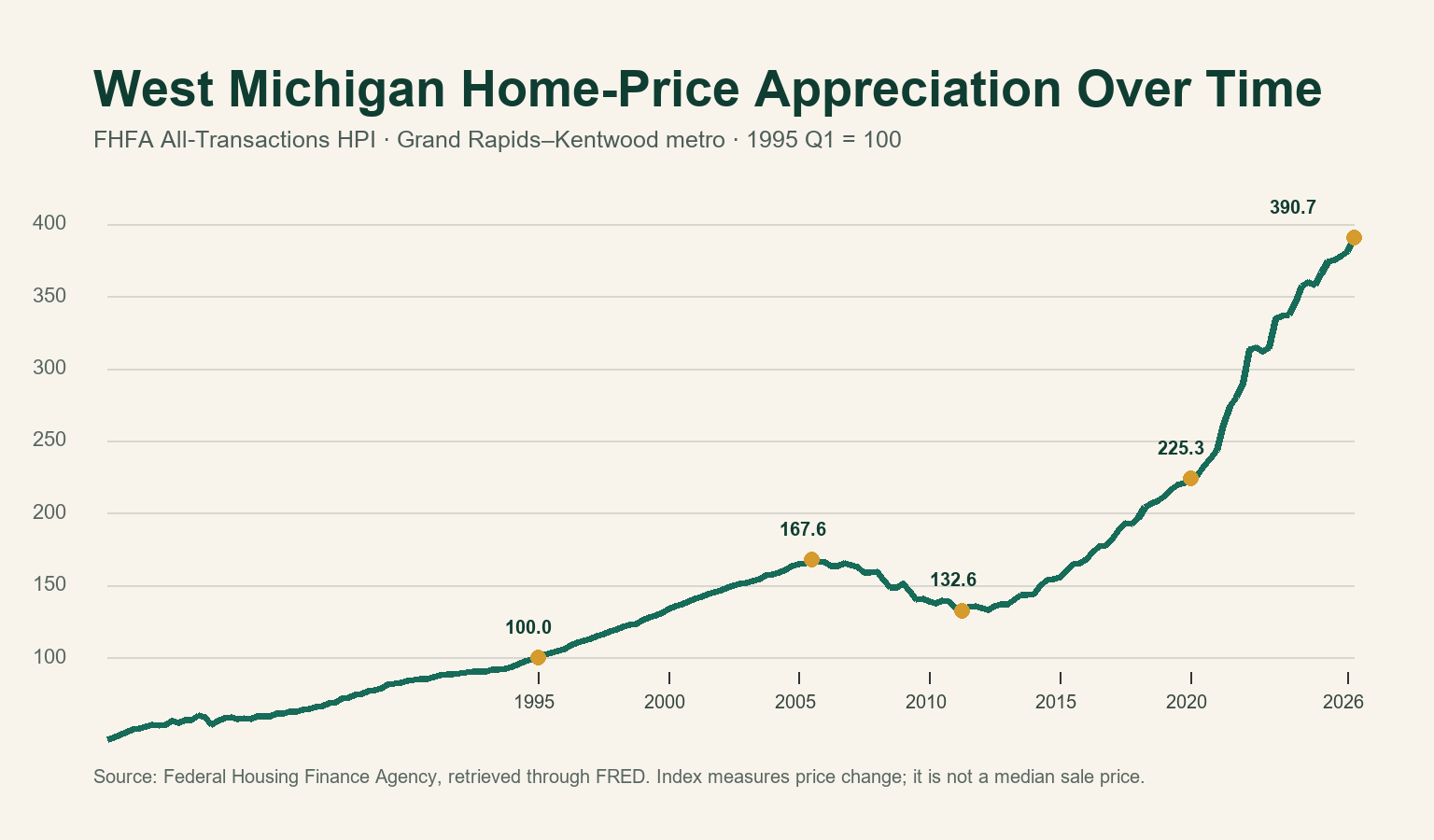
The index is set to 100 in the first quarter of 1995 and reached 390.73 in the second quarter of 2026. That represents about a 291% nominal increase from the starting level, or approximately 4.5% per year when compounded over a little more than 31 years. “Nominal” matters: this calculation does not subtract general inflation, ownership expenses, renovations, interest, taxes or selling costs. It describes regional price movement rather than an owner’s investment return.
Appreciation was not a straight line
West Michigan’s history includes a prolonged decline. The index reached about 167.6 in the third quarter of 2005 and later fell to roughly 132.6 in the second quarter of 2011—a decline of about 21%. It did not move above the earlier peak until several years later. A homeowner who needed to sell during that period could have experienced a very different outcome from someone who held the same home for decades.
The pace accelerated after the mid-2010s
The index was about 165.0 near the end of 2015, 237.4 near the end of 2020 and 378.1 near the end of 2025. From early 2020 through the second quarter of 2026, it rose about 74%. FHFA’s latest published metro table showed a 4.49% change over the most recent year and about 49.75% over five years for Grand Rapids–Wyoming–Kentwood. Those recent rates should not be projected indefinitely; short supply, household demand, mortgage rates, employment and construction can all change.
A home-price index is not your home’s value
An index summarizes a broad market. A specific home can perform differently because of location, school district, land, condition, size, improvements, deferred maintenance and the price originally paid. Even neighboring houses may not appreciate at the same rate. For a current decision, use recent comparable sales and a property-specific appraisal or market analysis rather than multiplying an old purchase price by the regional index.
Appreciation is different from equity
Equity is the property’s current value minus debt secured by it. Appreciation can add equity, and regular principal payments can add equity, too. Transaction costs, refinancing and additional borrowing can reduce what an owner ultimately keeps. A buyer should choose a payment that works without depending on future appreciation or a quick refinance.
What long-term appreciation means for first-time buyers
The history supports two ideas at the same time. Over long periods, West Michigan homeowners have generally experienced meaningful nominal appreciation. Over shorter periods, prices have declined and recovery has taken time. Buyers who expect to stay longer, maintain reserves and purchase within a comfortable budget are better positioned to live through normal market changes. A short planned holding period deserves a more conservative break-even analysis because buying and selling both involve costs.
Property taxes do not simply follow the seller’s current bill
Michigan’s taxable-value rules can make the prior owner’s tax bill a poor estimate for a buyer. The Michigan Department of Treasury explains that a transfer of ownership generally causes taxable value to uncap in the following calendar year. True cash value, assessed value and taxable value are related but distinct, and an assessor may not automatically set value at half the sale price. Buyers should request a post-transfer estimate from the local assessor and include it in the payment analysis.
How to use the history responsibly
Use historical appreciation as context, not a promise. Run the purchase using today’s total payment, cash required, repair needs and a realistic time in the home. Test a scenario with little or no appreciation and one in which selling costs are higher than expected. If the transaction only works when prices rise quickly, the plan is fragile. If it works as a place to live while preserving reserves, future appreciation can remain a potential benefit rather than a requirement.
Common questions
Does a 291% index increase mean every home gained 291%?
No. It is the change in a metro-wide repeat-transaction index from its 1995 benchmark. Individual properties and neighborhoods vary.
Does appreciation make buying risk-free?
No. Prices can decline, ownership has costs and the timing of a sale matters. The regional index fell about 21% from its mid-2000s peak to the 2011 trough.
Can this data predict next year?
No. It describes history. It should not replace a current property analysis, affordability review or household plan.
Sources and methodology
Data and sources reviewed September 3, 2026. Calculations use quarterly index observations and are rounded.
Reviewed by Mike Alkema
Mike Alkema, NMLS #642953, is a licensed mortgage loan originator with Leeward Point Mortgage LLC, NMLS #1823590. He reviewed this guide for practical mortgage context and advertising clarity. Historical appreciation is not a forecast or guarantee.
Put the market history in your budget
Compare today’s payment, cash needed and loan options without depending on future appreciation.